


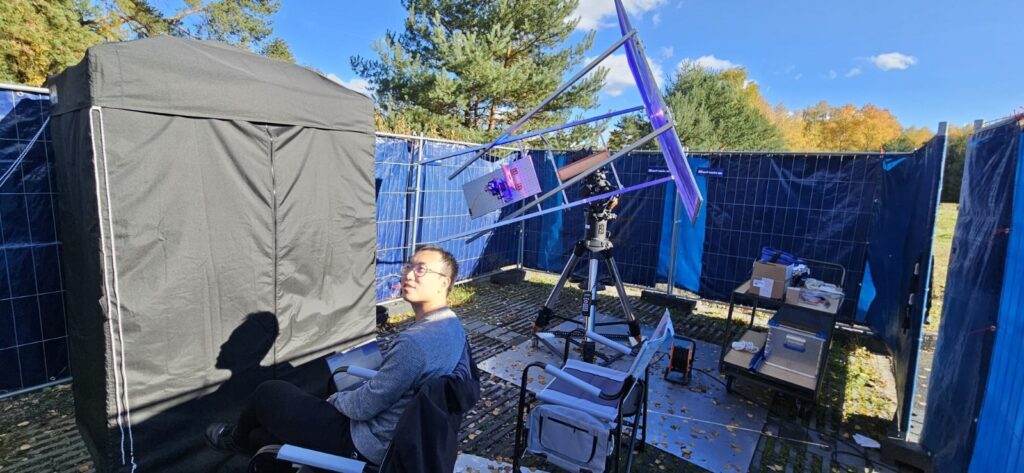
GENEVA, SWITZERLAND — Researchers have unveiled a groundbreaking sunlight-powered setup capable of generating quantum entanglement directly from ambient light sources, marking a major milestone for quantum communication networks.
Scientists have long struggled with the complexity and high power consumption required to maintain stable quantum states in optical laboratories. By harnessing natural solar radiation, this innovative photovoltaic-integrated optical system successfully streamlines the production of entangled photon pairs—the foundational building blocks of quantum cryptography and ultra-secure global networking.
Technical Breakdown and Innovation Mechanics
The newly developed apparatus utilizes specialized nonlinear crystals coupled with high-efficiency nanoscale photovoltaic cells to capture and convert ambient light into stable laser-equivalent optical pump beams.
-
Photon Pair Generation: The setup produces spontaneous parametric down-conversion driven entirely by solar-harvested energy rather than heavy grid electricity.
-
Decoherence Reduction: Advanced optical filtering techniques minimize environmental noise, allowing high-fidelity quantum correlation to persist even under fluctuating outdoor lighting conditions.
-
Scalability for Field Deployment: By eliminating the need for bulky laboratory laser systems and external power grids, the device opens the door to decentralized, field-deployable quantum nodes.
Implications for Global Quantum Networks
This technological leap addresses one of the primary logistical bottlenecks in scaling quantum key distribution (QKD) across vast geographic distances.
Future Applications and Next Steps
-
Satellite and Ground Links: Integrating solar-powered quantum transmitters into satellite arrays could drastically simplify space-to-ground quantum communication architectures.
-
Energy-Efficient Infrastructure: Reducing the carbon footprint and hardware overhead of quantum networks brings practical, planet-scale quantum internet closer to reality.










Comment