


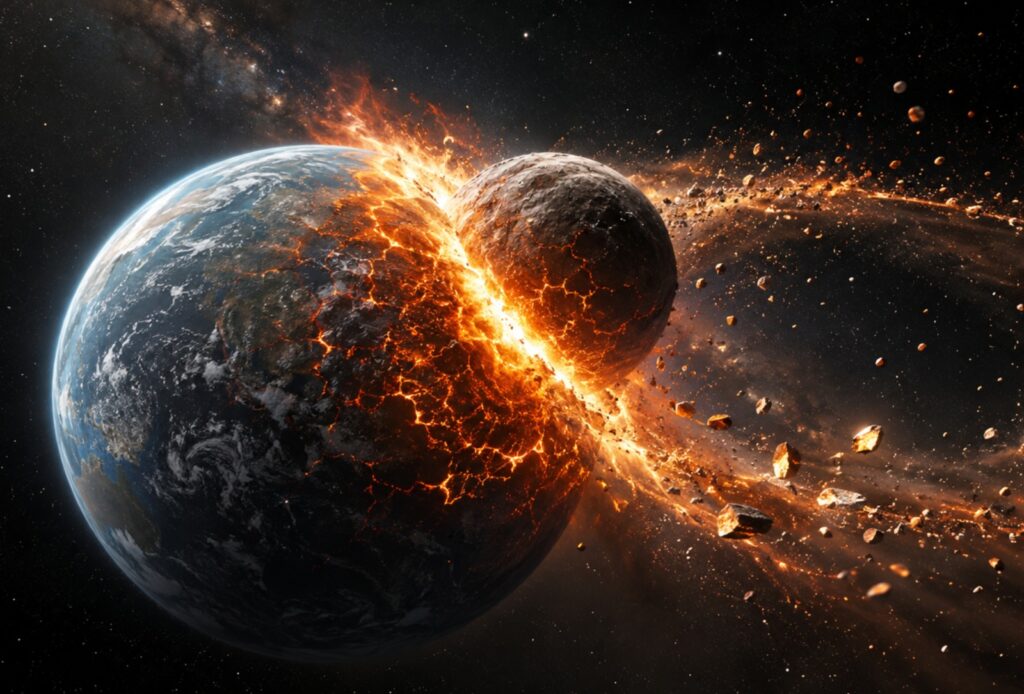
PASADENA, Calif. — Scientists have uncovered compelling evidence confirming that giant structures deep within Earth’s mantle are the ancient remnants of Theia, a Mars-sized protoplanet that collided with Earth roughly 4.5 billion years ago.
The groundbreaking study, led by an international team of geophysicists and planetary scientists, provides a definitive answer to a long-standing cosmic mystery—explaining both the origin of the Moon and the presence of massive, dense continent-sized anomalies buried thousands of miles beneath our feet.
Earth’s Deep-Mantle Anomalies Traced to Ancient Protoplanetary Impact
For decades, seismologists analyzing earthquake shockwaves noticed two colossal structures sitting at the base of Earth’s mantle, surrounding the core—one located beneath Africa and the other under the Pacific Ocean. Known technically as Large Low-Velocity Provinces (LLVPs), these dense region anomalies differ significantly in composition and temperature from the surrounding rock.
Advanced 3D computer simulations and geochemical modeling have now confirmed that these buried masses are fragments of Theia’s iron-rich mantle that sank and settled above Earth’s core following the primordial impact.
-
The Giant Impact Hypothesis: Approximately 4.5 billion years ago, the protoplanet Theia struck the early Earth. While debris blasted into orbit eventually coalesced to form the Moon, significant portions of Theia sank deep into Earth’s interior.
-
Higher Density Composition: Seismological data reveals that LLVPs are 2% to 3.5% denser than the surrounding mantle material, consistent with the iron-rich composition expected from Theia’s mantle.
-
Preserved Primordial Material: Due to stable convection currents near Earth’s core-mantle boundary, these continent-sized structures have remained largely unmixed for billions of years.
Theia Impact & Earth Mantle Remnants Overview:
• Event Age: ~4.5 Billion Years Ago (Hadean Eon)
• Protoplanet Size: Mars-sized body (Theia)
• Internal Location: Base of Earth's mantle (Core-Mantle Boundary, ~2,900 km deep)
• Geological Term: Large Low-Velocity Provinces (LLVPs)
• Key Evidence: High-density seismic wave delays & thermomechanical 3D simulations
• Primary Result: Formation of the Moon & preservation of extraterrestrial mantle slabs inside Earth
How Theia’s Interior Shaped Earth’s Evolution and Moon Formation
The discovery provides a unified framework connecting Earth’s internal structure to external planetary dynamics during the early evolution of the Solar System.
Key Insights from the Study
-
Origins of the Earth-Moon System: The research confirms that the Moon is composed largely of material ejected from Theia’s outer layers, while the heavier, iron-rich mantle core of the protoplanet sank into Earth.
-
Driving Forces Behind Plate Tectonics: Heat generated by these dense, iron-rich mantle blobs may have influenced mantle plumes and volcanic hot spots—such as Hawaii and Iceland—potentially helping kickstart Earth’s early plate tectonics.
-
Implications for Exoplanet Discovery: Understanding how large impacts leave permanent signatures inside terrestrial planets will help astronomers evaluate the internal structure and habitability of rocky exoplanets across other star systems.
Future Planetary Science and Geodynamic Research
As geophysical imaging techniques improve, scientists plan to conduct higher-resolution seismic surveys to map the exact boundaries of these deep-mantle structures.
For additional details on planetary science breakthroughs and earth evolution research, visit The Brighter Side of News.










Comment