


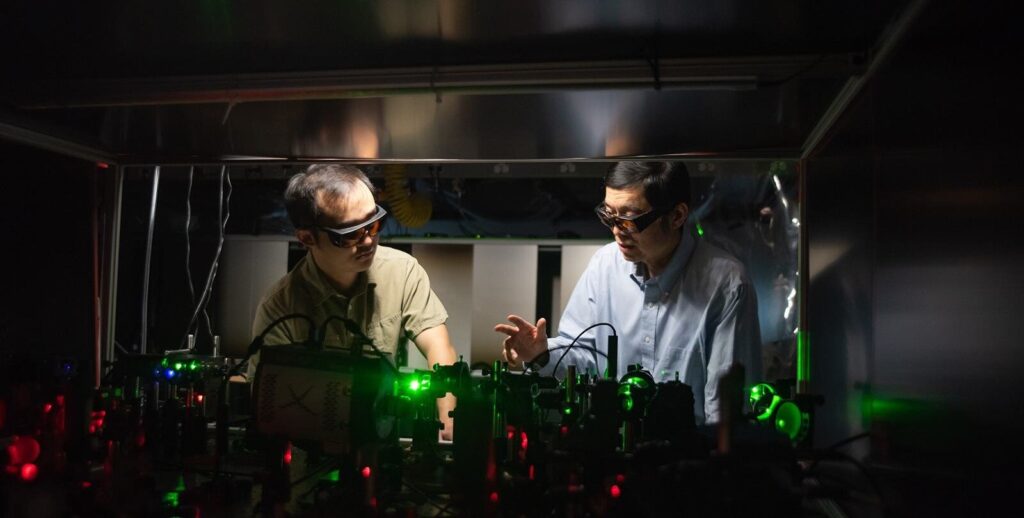
GENEVA, SWITZERLAND — Physicists at the forefront of optical engineering have developed a revolutionary quantum microscopy technique that quadruples the resolution limits of traditional light microscopes, opening unprecedented avenues in cellular biology and nanotechnology.
For centuries, optical imaging has been bound by the Abbe diffraction limit, a fundamental physical constraint that restricts how closely two points of light can be resolved under a microscope. Traditional fluorescence and laser-scanning microscopes have pushed these boundaries using complex fluorescent markers and super-resolution algorithms, but they remain vulnerable to phototoxicity and optical noise.
By harnessing the principles of quantum entanglement and specialized photon-pair correlation, researchers have successfully bypassed conventional diffraction barriers without damaging delicate biological samples.
Mechanics of Quantum-Enhanced Imaging
The innovative setup utilizes entangled photon pairs generated through spontaneous parametric down-conversion, effectively doubling the momentum transfer and achieving an equivalent fourfold improvement in spatial resolution.
-
Non-Destructive Illumination: The technique requires significantly lower light intensity compared to standard high-powered lasers, preventing thermal damage and photobleaching in live biological specimens.
-
Sub-Diffraction Precision: By measuring spatial correlations between photon pairs rather than relying purely on intensity reflections, the microscope maps nanoscale cellular structures with unprecedented clarity.
-
Noise Suppression: Advanced quantum coincidence filtering algorithms isolate true signals from background interference, drastically improving image contrast in dense biological environments.
Implications for Life Sciences and Advanced Materials
The commercial and scientific ramifications of quadrupled optical resolution extend far beyond academic laboratories.
Future Applications and Industry Impact
-
Cellular and Molecular Biology: Researchers can now observe subcellular organelles, protein interactions, and viral structures in real-time with unprecedented structural accuracy.
-
Nanotechnology Manufacturing: The technique offers microchip manufacturers and materials scientists a non-destructive tool to inspect microscopic defects in semiconductor wafers and quantum computing components.












Comment