


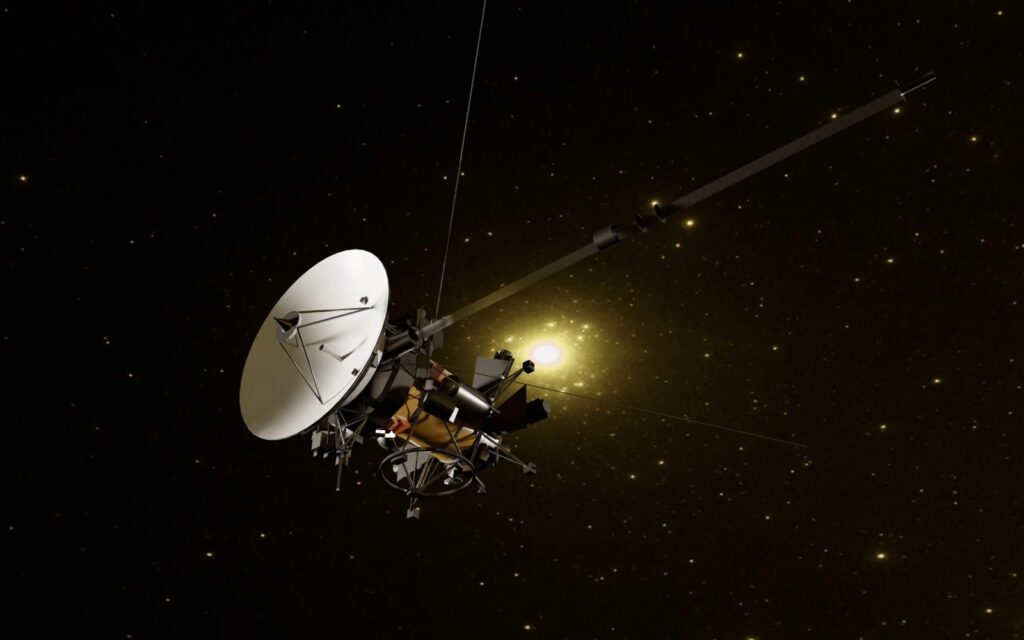
PASADENA, Calif. — NASA engineers at the Jet Propulsion Laboratory (JPL) are racing against time and physics to keep humanity’s farthest-flung probes operational, testing a complex power management patch on Voyager 1 to extend its mission after the spacecraft was reduced to just two functioning scientific instruments.
The creative fix, which successfully bought twin probe Voyager 2 an extra year of science operations, involves reallocating backup power reserved for an onboard safety mechanism—a crucial intervention as both interstellar spacecraft approach 50 years in deep space.
Voyager 1 Down to Two Operating Science Instruments in Interstellar Space
As the nuclear-powered radioisotope thermoelectric generators (RTGs) aboard the Voyager probes lose roughly 4 watts of power per year, mission managers have been forced to systematically shut down non-essential systems and scientific payloads to keep primary thrusters and transmitters running.
Voyager 1, currently floating over 15 billion miles (24 billion kilometers) from Earth, is now down to just two active scientific instruments:
-
Magnetometer (MAG): Measuring magnetic fields in interstellar space beyond the heliosphere.
-
Plasma Wave Subsystem (PWS): Tracking interstellar plasma density and solar storm impacts.
All other instruments—including primary cameras, cosmic ray sensors, and particle detectors—have been turned off or failed due to age and extreme sub-zero temperatures.
Voyager Probes Status Comparison:
• Distance from Earth: Voyager 1 (~15.2 Billion Miles) | Voyager 2 (~12.6 Billion Miles)
• Active Instruments: Voyager 1 (2 Instruments) | Voyager 2 (3 Instruments)
• Power Source: Radioisotope Thermoelectric Generators (Plutonium-238)
• Communications Delay: ~22.5 Hours One-Way Signal Time to Earth
The Voltage Regulator Patch: How NASA Buys Extra Time in Interstellar Space
To keep Voyager 2 running without turning off its remaining instruments last year, engineers disabled a voltage regulator safety circuit that protects against unexpected power spikes. Because the spacecraft’s power system has proven remarkably stable over nearly five decades, NASA repurposed that small reserve of safety voltage directly back into the scientific instruments.
Testing the Fix on an Aging Spacecraft
-
Unpredictable Systems: Applying the fix to Voyager 1 carries risks. NASA engineers noted that Voyager 1 “no longer behaves quite like its sister probe,” exhibiting unexpected sensor glitches and unique memory corruption issues in recent years.
-
Deep Space Communication Delays: Commands sent via NASA’s Deep Space Network take over 22 hours to reach the spacecraft and another 22 hours to return confirmation to Earth.
-
Calculated Risk: Mission directors determined that accepting the minor risk of an unregulated voltage spike is preferable to shutting down another invaluable science instrument in interstellar territory.
Humanity’s Longest Interstellar Journey Continues
Launched in 1977 to explore Jupiter and Saturn, both Voyager spacecraft crossed the heliopause—the outer boundary of the Sun’s magnetic field—and entered interstellar space, providing unprecedented data about the space between stars.
While their power output will eventually drop below the threshold needed to transmit signals to Earth by the late 2020s or early 2030s, the golden records aboard both probes will continue drifting silently through the Milky Way galaxy for millions of years.












Comment