


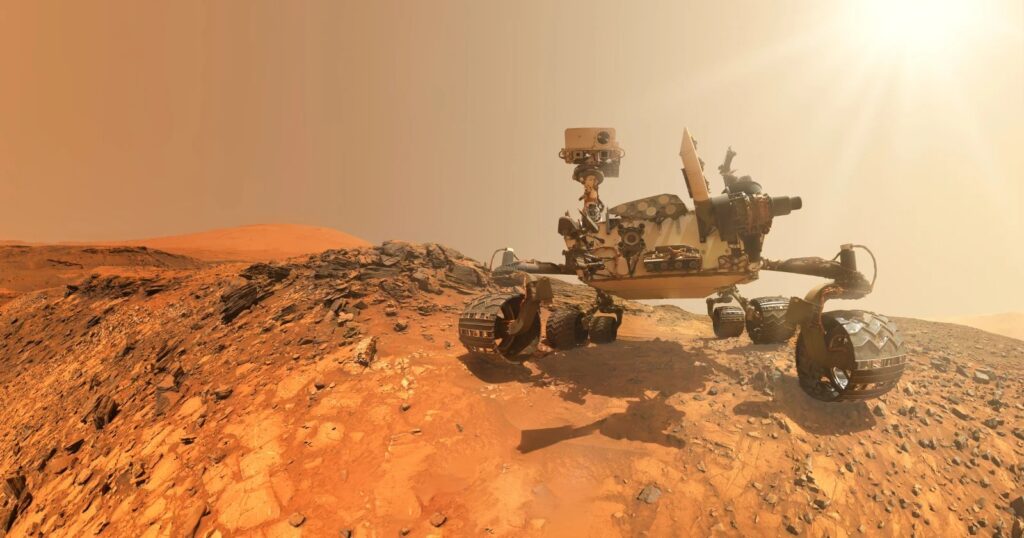
MUSCAT, Oman & PASADENA, Calif. — A dark, heavy rock picked off the gravel desert plains of Oman in 1999 has completed an extraordinary interplanetary round trip. Known officially as Sayh al Uhaymir 008 (SaU 008), the specimen was blasted off the surface of Mars millions of years ago by an asteroid impact, traveled through deep space, landed in the Middle East, and has now returned home to the Red Planet.
Serving as a precise calibration target aboard NASA’s Perseverance rover in Jezero Crater, this ancient piece of Martian crust is helping scientists analyze new rock samples on the world it once called home.
From the Omani Desert to NASA’s Jet Propulsion Laboratory
The meteorite’s journey began eons ago when a massive impactor struck Mars, ejecting rock fragments into space. After drifting through the solar system, one piece fell to Earth in Oman’s Al Wusta region, where geologists discovered it on the arid gravel plains in 1999.
Careful laboratory analysis confirmed its Martian origin through its chemical signature, matching noble gas concentrations trapped inside the rock to atmospheric data collected by NASA’s Viking landers in the 1970s.
SaU 008 Meteorite Fast Facts:
• Discovery Date: 1999
• Discovery Location: Sayh al Uhaymir, Oman
• Classification: Basaltic Shergottite (Martian Volcanic Rock)
• Return Mission: NASA Mars 2020 Perseverance Rover
• Instrument Location: SHERLOC Instrument (Calibration Target)
How SaU 008 Calibrates Perseverance’s SHERLOC Instrument
When NASA designed the Perseverance rover to search for signs of ancient microscopic life in Jezero Crater, scientists needed an exact baseline material to calibrate high-precision laser instruments on the Martian surface.
Mounted on the rover’s robotic arm, SaU 008 serves as a vital component of the SHERLOC (Scanning Habitable Environments with Raman & Luminescence for Organics & Chemicals) instrument:
-
Laser Calibration: SHERLOC uses an ultraviolet laser to detect organic compounds and minerals. Before firing at unstudied Martian rocks, the instrument targets SaU 008 to ensure its sensors are calibrated correctly in the harsh Martian atmosphere.
-
Comparative Geology: Scientists can directly compare the chemical composition of newly discovered Jezero Crater rocks against the known baseline of SaU 008, accounting for temperature and dust fluctuations.
-
Resisting Environmental Wear: Because SaU 008 is a tough basaltic rock, it withstands the intense UV radiation and temperature swings on Mars, keeping its structural properties stable over time.
Paving the Way for Mars Sample Return Missions
The presence of SaU 008 on Perseverance highlights a unique full-circle moment in planetary science: humanity using a piece of Mars to study Mars.
As Perseverance continues gathering sealed rock cores across Jezero Crater, the calibration provided by SaU 008 ensures that future joint NASA–ESA Mars Sample Return missions bring back the most scientifically valuable samples to Earth for deep study.











Comment