


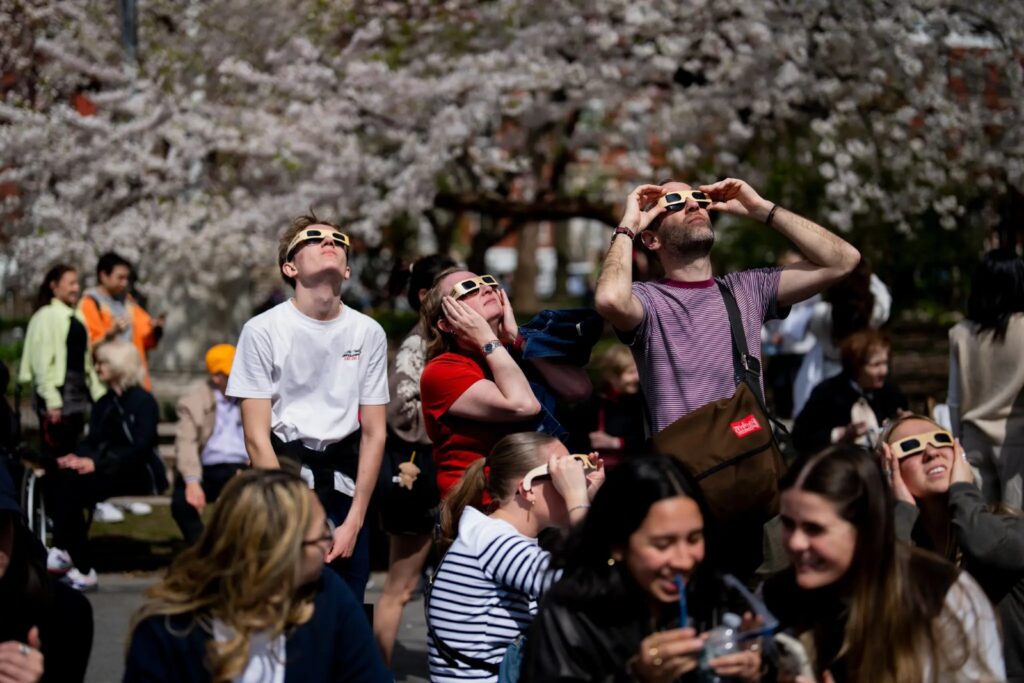
MADRID & REYKJAVIK — Millions of skywatchers, scientists, and travelers gathered across Europe, Greenland, and Iceland as a dramatic total solar eclipse swept through the region, marking the continent’s first total solar eclipse since 1999.
The moon’s shadow made initial landfall over northeastern Greenland before racing across western Iceland, crossing the Atlantic Ocean, and tracking through northern Spain and a portion of Portugal before concluding over the Mediterranean Sea.
Path of Totality Brings Midday Twilight to Iceland and Spain
The path of totality—a narrow corridor where the moon completely obscures the sun—brought up to 2 minutes and 18 seconds of total darkness during peak afternoon and evening hours.
-
Landfall in Greenland & Iceland: The lunar shadow hit western Iceland, where Reykjavik hosted public celebrations and festivals as locals experienced their first total eclipse since 1954.
-
Sunset Eclipse in Spain: In northern and eastern Spanish cities like Santander, Bilbao, Zaragoza, A Coruña, and Valencia, as well as the Balearic Islands, observers witnessed a rare “sunset eclipse,” with the sun fully obscured low on the horizon.
-
Environmental Impact: During totality, temperatures dropped by several degrees, winds subsided, and wildlife responded to the sudden darkness with birds quieting and crickets chirping.
2026 European Total Solar Eclipse At A Glance:
• Path of Totality: Greenland, Iceland, Northern Spain, Portugal, Balearic Islands
• Maximum Totality Duration: ~2 minutes 18 seconds
• Significance: First total solar eclipse in mainland Europe since 1999
• Partial Eclipse Reach: UK, France, Germany, Ireland, Eastern US/Canada, North Africa
Deep Partial Eclipse Witnessed by Millions Across the Globe
While only an estimated 15 million people were located directly inside the path of totality, nearly a billion people across the Northern Hemisphere witnessed varying degrees of a partial eclipse.
Regional Viewing Highlights
-
United Kingdom & Ireland: Major cities and coastal regions saw over 90% of the sun covered, casting an eerie twilight glow across the landscape.
-
Continental Europe: Broad coverage across France, Germany, Italy, and Scandinavia allowed millions to view crescent-shaped shadows through ISO-certified eclipse glasses.
-
North America: Observers in parts of Alaska, Canada, and the northeastern United States caught a light to moderate partial eclipse during morning and afternoon hours.
Tourism Boost and Scientific Research Missions
The eclipse sparked unprecedented demand for hospitality and travel across host countries, with hotels in Spain and Iceland reaching 100% occupancy months in advance. Airlines also operated specialized observation flights along the path of totality.
Concurrently, NASA and international research institutions deployed high-altitude research aircraft, balloons, and ground teams to study the sun’s outer atmosphere (the corona) and observe real-time atmospheric changes triggered by the sudden shadow.










Comment