


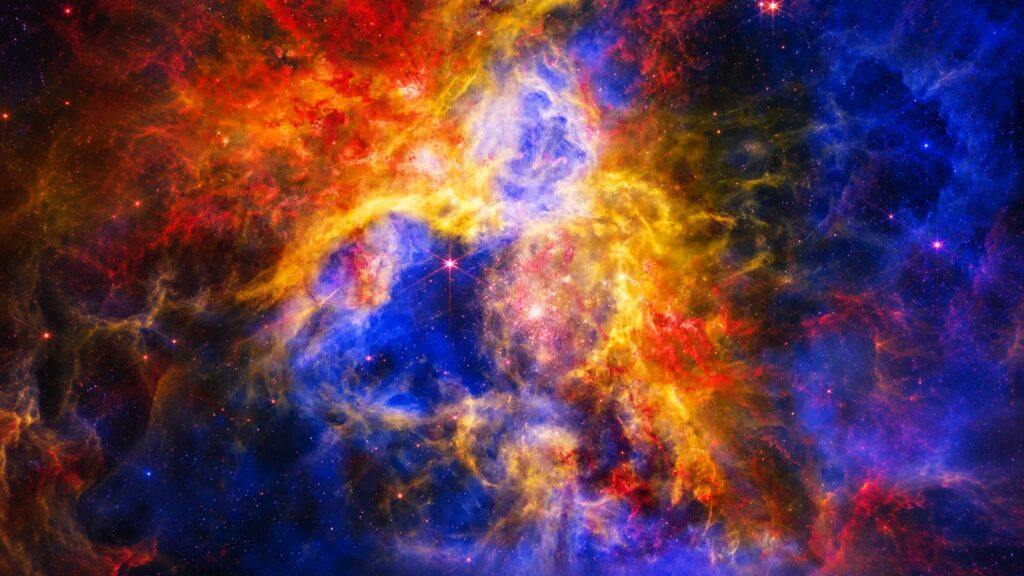
GREENBELT, Md. — NASA scientists have released stunning, high-resolution new images of the Tarantula Nebula, offering astronomers and space enthusiasts an unprecedented look at one of the most active star-forming regions in our local universe.
Located roughly 161,000 light-years away in the Large Magellanic Cloud, the cosmic nursery is home to some of the hottest and most massive stars ever discovered, providing a vital laboratory for studying stellar evolution.
What the New Tarantula Nebula Images Reveal About Star Formation
The newly processed imagery combines multi-wavelength observations to pierce through thick cosmic dust clouds, exposing thousands of previously hidden protostars and complex gas filaments.
-
Massive Star Cluster 30 Doradus: The central cluster shines with extreme intensity, carving massive cavities into surrounding gas clouds via high-energy radiation and intense stellar winds.
-
Infrared & Optical Clarity: Advanced sensor processing reveals fine, web-like tendrils of hydrogen and helium gas—giving the nebula its iconic spider-like name.
-
Extreme Starbirth Rates: Scientists note that the Tarantula Nebula is producing stars at a rate significantly higher than any star-forming region within our own Milky Way galaxy.
Tarantula Nebula Science & Discovery Overview:
• Official Catalog Name: 30 Doradus / NGC 2070
• Distance from Earth: ~161,000 Light-Years (Large Magellanic Cloud)
• Key Target Area: High-mass star-forming region and protostellar cores
• Primary Instruments Used: Space-based optical and deep infrared sensors
• Scientific Importance: Closest example of intense, early-universe star formation
Why the Tarantula Nebula Matters to Cosmic Research
Because the chemical composition of the Tarantula Nebula resembles the conditions of the cosmos when it was only a few billion years old, studying this region gives astrophysicists a front-row seat to the early universe.
Key Takeaways from NASA’s Latest Release
-
Uncovering Hidden Protostars: Infrared imaging allows researchers to peer inside dark molecular clouds where infant stars are actively accumulating mass.
-
Supernova Precursors: The region contains massive stars nearing the end of their lifecycles, which will eventually explode as supernovas and enrich space with heavy elements.
-
Paving the Way for Future Observations: The new image mapping serves as a foundational baseline for targeted follow-up studies using orbital and ground-based observatories worldwide.
Global Impact on Space Exploration and Astronomy
The release of these detailed visuals not only expands scientific understanding of galaxy formation and starbirth mechanics, but also provides the public with breathtaking, desktop-worthy views of deep space.
As processing continues on incoming deep-space survey data, NASA and its international partners plan to release further multi-spectral maps of neighboring cosmic structures in the coming months.










Comment