


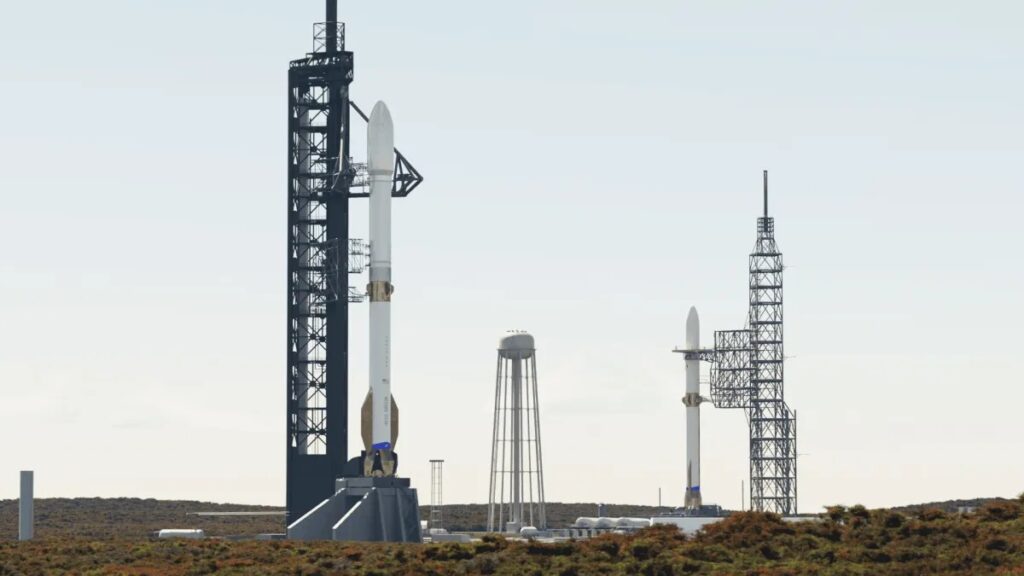
CAPE CANAVERAL, Fla. — Spaceflight company Blue Origin has disclosed new plans to rebuild and expand its primary Florida launch complex.
The company is developing a second launch pad at Launch Complex 36 (LC-36B) at Cape Canaveral Space Force Station. The new pad is designed to support high-cadence launch operations for the upgraded New Glenn 9×4 heavy-lift rocket variant.
Expanding LC-36 to Support Heavy-Lift Rocket Launch Cadence
The expansion comes as repairs and rebuild efforts continue at neighboring Launch Complex 36A (LC-36A) following an engine static-fire anomaly in May 2026.
Rather than focusing solely on repairs, Blue Origin is leveraging the site reconstruction to establish a dual-pad operational model at the historic launch site.
-
Dedicated Pad Strategy: LC-36A will remain the operational home for the standard 7×2 New Glenn rocket, while the new LC-36B will host the larger 9×4 variant.
-
New Integration & Payload Facilities: The project includes constructing a dedicated Vertical Integration Facility (VIF) tailored for the 9×4 vehicle.
-
National Security Space Support: In partnership with the U.S. government, Blue Origin is building a shared Payload Processing Facility (PPF) to support both New Glenn configurations and National Security Space Launch (NSSL) partners.
Blue Origin Launch Infrastructure Snapshot:
• Location: Launch Complex 36, Cape Canaveral Space Force Station, Florida
• Pad LC-36A: Dedicated to New Glenn 7x2 vehicle operations
• Pad LC-36B: Dedicated to New Glenn 9x4 upgraded variant
• Supporting Facilities: Vertical Integration Facility (VIF) & Payload Processing Facility (PPF)
• Target Capabilities: Extended payload capacity, trans-lunar injection, NSSL mission support
Next-Generation Capabilities of the New Glenn 9×4 Rocket
The upgraded New Glenn 9×4 configuration represents a significant leap in commercial heavy-lift payload capacity, featuring nine first-stage engines and four upper-stage engines.
Strategic Milestones for the Upgraded Fleet
-
Payload Capacity Upgrade: Designed to deliver over 70 metric tons to Low Earth Orbit (LEO), 14 metric tons to Geosynchronous Transfer Orbit (GTO), and more than 20 metric tons on Trans-Lunar Injection (TLI) trajectories.
-
Expanded Fairing Volume: The 9×4 variant will utilize an 8.7-meter payload fairing—up from the 7-meter fairing on the standard New Glenn vehicle.
-
High Launch Cadence: Dual-pad infrastructure will allow Blue Origin to prepare multiple rockets simultaneously, significantly reducing turnaround times between missions.
Advancing U.S. Space Force and Commercial Capabilities
By expanding infrastructure at Cape Canaveral Space Force Station, Blue Origin positions itself to compete aggressively for high-priority commercial satellite deployments, NASA lunar exploration missions, and U.S. Space Force launch manifests.
Construction on LC-36B and supporting facilities is underway as Blue Origin prepares to resume New Glenn launches later this year.










Comment