


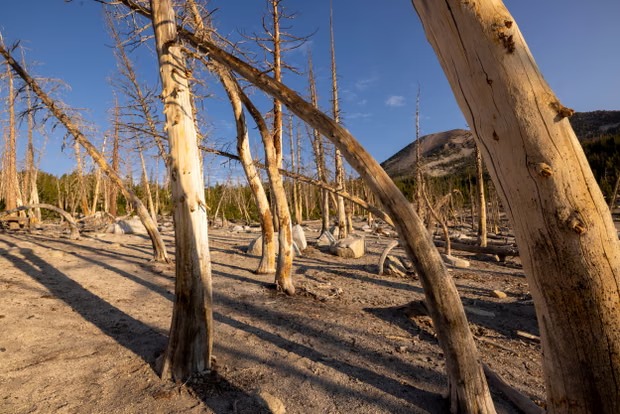
LOS ANGELES — A landmark study published in the journal Science reveals that soaring carbon dioxide emissions cause global forests to wither and die rather than flourish.
The findings directly counter long-held political claims—including arguments put forward by members of the Trump administration—that fossil fuel pollution acts as a beneficial plant fertilizer that will ultimately “green the planet.”
Prehistoric Leaf Fossils Expose the Myth of Carbon-Induced ‘Greening’
Conducted by researchers at the La Brea Tar Pits and the Natural History Museum of Los Angeles County, the study analyzed fossilized leaf cells from the Paleocene-Eocene Thermal Maximum (PETM).
Occurring roughly 56 million years ago, the PETM saw rapid releases of planet-heating gases and global temperature spikes of up to 8°C (14°F), providing the closest historical comparison to modern fossil fuel emissions.
-
Massive Biomass Loss: Lead researcher Dr. Regan Dunn noted that during the PETM, initial forest thickening was quickly followed by a catastrophic collapse, destroying nearly 60% of standing vegetation biomass.
-
Canopies Remained Open: Instead of expanding, ancient forest canopies thinned dramatically and remained open for tens of thousands of years.
-
Heat and Water Stress Override CO₂: Extra carbon dioxide trapped excessive heat, disrupting plant physiology and water regulation until trees suffered severe dehydration and die-back.
Paleocene-Eocene Thermal Maximum (PETM) vs. Modern Carbon Release:
• Historical Reference Event: Paleocene-Eocene Thermal Maximum (~56 Million Years Ago)
• Ancient Temperature Shift: Global warming of up to 8°C (14°F) over 130,000 years
• Key Study Finding: ~60% loss of standing forest biomass during ancient carbon spike
• Modern Pace Disparity: Current carbon emissions are surging faster than PETM rates
• Modern Transition Point: Forests began shifting from greening to browning around 2000
Escalating Global Tree Mortality Demands Immediate Climate Action
Scientists warn that Earth transitioned from a phase of CO₂-driven greening to climate-driven forest browning around the year 2000, as heatwaves and severe droughts began overwhelming any potential fertilization benefits.
Independent experts, including UC Berkeley scientist Trevor Keenan, highlight that modern ecosystems face an even greater threat than prehistoric forests due to human fragmentation, deforestation, and active logging.
Key Takeaways from Climate Scientists
-
Current Forest Die-Offs: Widespread tree mortality is already being documented across North America, Europe, and the Amazon basin due to severe heat and drought.
-
Unprecedented Emission Rates: Today’s burning of coal, oil, and gas is releasing carbon dioxide across decades rather than the thousands of years seen during the PETM, giving ecosystems far less time to adapt.
-
Keep Fossil Fuels in the Ground: Researchers stress that swift cuts to global emissions are essential to prevent modern forest ecosystems from collapsing past points of recovery.
Protecting Global Carbon Sinks for Long-Term Recovery
Because recovery periods from major atmospheric carbon thresholds take tens of thousands of years, scientists emphasize that preserving existing forests and phasing out fossil fuels remain Earth’s most urgent line of defense.











Comment