


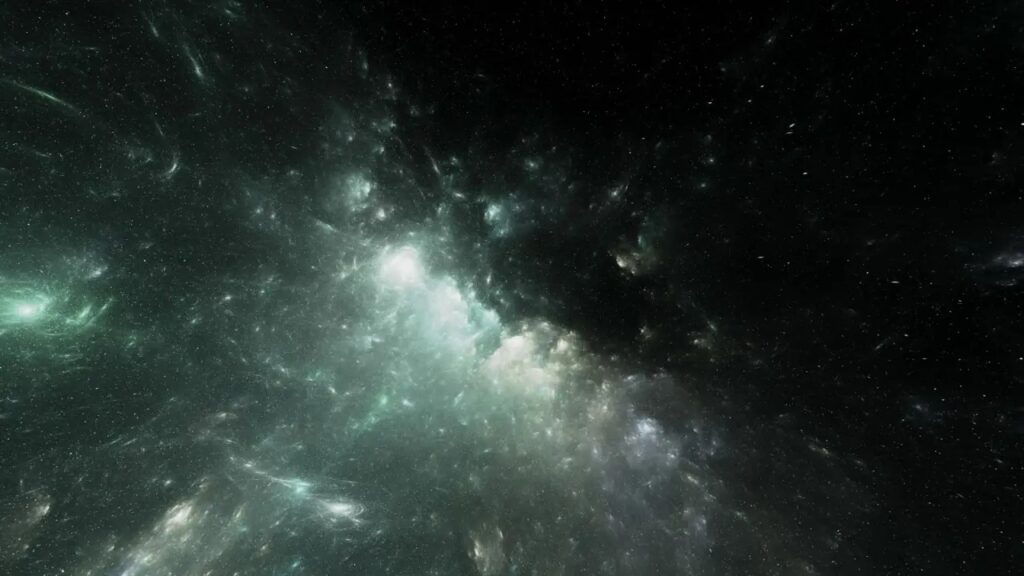
BARCELONA, Spain — A team of theoretical physicists led by the University of Barcelona’s Institute of Cosmos Sciences (ICCUB) and the University of Padua has proposed a revolutionary model detailing the earliest moments of the Universe.
Published in Physical Review Research, the study introduces a minimalist framework that explains how cosmic structure formed immediately after the Big Bang without relying on speculative, unobserved physical fields.
Replacing Speculative Inflationary Models with Fundamental Physics
For decades, the dominant cosmological paradigm has relied on cosmic inflation—a hypothesis suggesting that the Universe expanded at an exponential rate during a tiny fraction of a second. While cosmic inflation solves several key cosmological puzzles, traditional models depend on hypothetical particles (such as the “inflaton”) and multiple adjustable free parameters.
The newly proposed model eliminates these arbitrary variables entirely, anchoring the birth of the Universe in known physical principles.
-
No Speculative Fields Required: Unlike traditional inflation theories, the new model operates without assuming unverified fields or undiscovered fundamental particles.
-
De Sitter Space Foundation: The Universe begins from a well-understood cosmic state known as de Sitter space, which directly aligns with modern dark energy observations.
-
Elimination of Free Parameters: By removing adjustable parameters, the theory provides a rigid framework that makes clear, verifiable predictions rather than fitting existing data retrospectively.
Cosmological Paradigm Comparison:
• Traditional Inflation: Relies on hypothetical inflaton fields & fine-tuned free parameters
• New ICCUB/Padua Model: Uses de Sitter space, standard gravity & quantum mechanics
• Primary Driver of Structure: Quantum gravitational wave fluctuations
• Key Advantage: Fully testable, minimal assumptions, no speculative particles needed
Quantum Gravitational Waves Seeded Galaxies and Cosmic Structure
Instead of invoking exotic scalar fields to explain density variations in the early Universe, the researchers demonstrate that natural quantum fluctuations in space-time—gravitational waves—were sufficient to initiate cosmic structure.
As these microscopic gravitational ripples evolved non-linearly, their interactions created the density variations that eventually collapsed under gravity to form stars, galaxies, and planetary systems.
Key Takeaways from the Research
-
Verifiable Predictions: Because the model relies strictly on general relativity and quantum mechanics, it produces specific signatures that future observatories can test.
-
Testing via Gravitational Wave Detectors: Next-generation space-based and ground-based gravitational wave observatories will be able to measure primordial background ripples to confirm or refute the hypothesis.
-
A Paradigm Shift in Cosmology: If validated by observational data, the theory could fundamentally reshape astrophysics textbooks by simplifying our understanding of cosmic origin.
Observational Horizon and Future Validation
As researchers analyze high-precision cosmic microwave background (CMB) maps and await data from upcoming gravitational wave detectors, this minimalist theory offers an elegant alternative to decades of complex inflationary math.
For complete study details and mathematical derivations, refer to the peer-reviewed research published in Physical Review Research.








Comment