


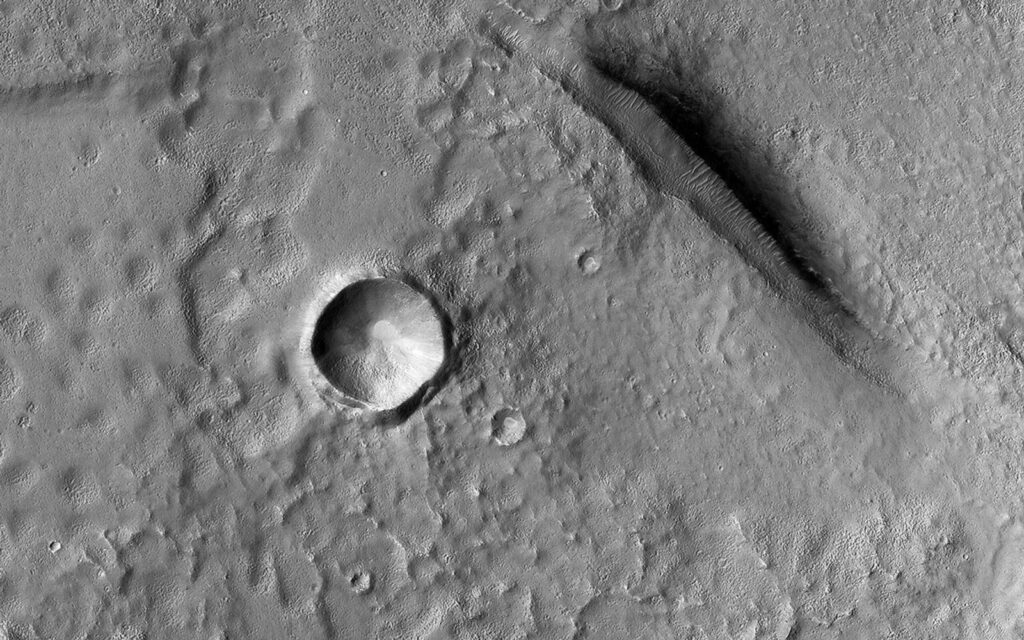
BEIJING — In a major breakthrough for planetary science and the search for ancient habitability, researchers analyzing data from China’s Zhurong Mars rover have identified hydrated gypsum crystals containing liquid brine inclusions dating back 760 million years.
The findings, published by scientists at the Chinese Academy of Sciences, offer direct evidence that liquid water persisted on the Martian surface far longer than previously estimated by mainstream geological models.
Zhurong Rover Uncovers Evidence of Late Liquid Water on Mars
The discovery was made during Zhurong’s ongoing exploration of Utopia Planitia, a vast impact basin in Mars’ northern lowlands. Using its onboard Multispectral Camera (MSCam) and Laser-Induced Breakdown Spectroscopy (LIBS) instruments, the rover conducted close-range chemical analyses of exposed sedimentary rocks and surface crusts.
The spectral data confirmed the presence of calcium sulfate dihydrate—commonly known as gypsum—trapped within shallow sub-surface layers.
-
Hydrated Mineral Formations: Spectroscopic analysis revealed distinct hydration signatures characteristic of gypsum crystals formed through evaporation processes in saline water bodies.
-
Microscopic Fluid Inclusions: High-resolution imaging and elemental mapping detected tiny pockets of liquid brine trapped within the crystal lattice structures.
-
Extended Aqueous Timeline: Radiometric dating of surrounding geological formations places the age of these gypsum deposits at approximately 760 million years old (during the Amazonian epoch), proving liquid water existed during Mars’ modern, cold-and-dry era.
Zhurong Mars Discovery Breakdown:
• Mission / Rover: Tianwen-1 / Zhurong Rover (CNSA)
• Landing Site: Utopia Planitia, Northern Lowlands of Mars
• Mineral Identified: Calcium Sulfate Dihydrate (Gypsum)
• Key Finding: Liquid brine inclusions trapped within crystal structures
• Estimated Deposit Age: ~760 Million Years Ago (Amazonian Period)
• Scientific Impact: Rewrites timeline for liquid water and potential microbial habitability on Mars
Implications for Martian Habitability and Future Sample Return Missions
Prior to this discovery, scientific consensus held that Mars lost most of its surface water nearly 3 billion years ago during the transition from the Noachian to the Hesperian era. The existence of liquid brine during the late Amazonian period suggests localized hydrothermal or salt-driven melting processes supported intermittent liquid environments much closer to the present day.
Why Gypsum and Brine Inclusions Matter for Planetary Science
-
Preservation of Ancient Biomarkers: On Earth, fluid inclusions inside evaporite minerals like gypsum are known to preserve organic molecules, amino acids, and micro-fossils for hundreds of millions of years.
-
Targets for Sample Return: These sulfate-rich formations in Utopia Planitia serve as primary high-priority targets for future Mars sample return (MSR) concepts to search for signs of past biosignatures.
-
Understanding Climate Evolution: The presence of late-stage liquid brine helps geologists refine climate models to explain how temporary liquid water existed under thin atmospheric pressure and freezing surface temperatures.
Future Exploration at Utopia Planitia
As international space agencies prepare for next-generation robotic and crewed missions to the Red Planet, the Zhurong rover’s discovery places Utopia Planitia alongside Jezero and Gale craters as one of the most scientifically valuable regions on Mars.












Comment