


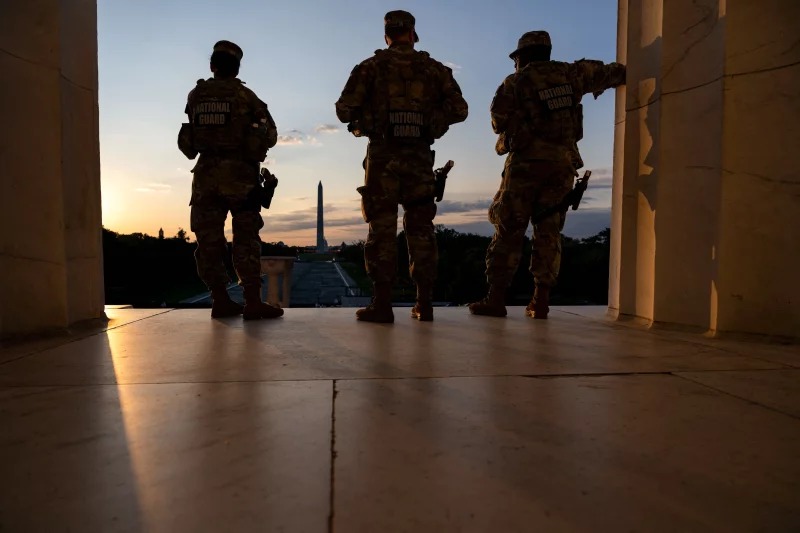
WASHINGTON — One year after President Donald Trump initially deployed National Guard troops to Washington, D.C., under a temporary “crime emergency” declaration, thousands of armed, uniformed service members have quietly become an everyday fixture across the nation’s capital.
Despite the initial emergency order expiring a month after its launch, the military presence has expanded into the longest and largest domestic deployment in the district’s recent history—with federal authorization quietly extended through Inauguration Day in January 2029.
Expanding Force: From 800 Local Guardsmen to 5,000 Multi-State Troops
What began in August 2025 as a localized task force of roughly 800 District of Columbia National Guard members has grown significantly over the past 12 months.
Because Washington, D.C., is a federal district rather than a state, the U.S. president exercises direct executive authority over its National Guard forces. Following the initial declaration, more than 20 Republican governors dispatched additional Guard units to support federal operations, surging total troop levels to nearly 5,000.
-
Presence Patrols: Uniformed service members conduct daily visibility patrols across transit hubs, commercial centers, residential neighborhoods, and iconic National Mall monuments.
-
Detention vs. Arrest Powers: While Guard members lack civilian arrest authority and traditional law enforcement training, they maintain legal authority to detain individuals until local law enforcement arrives.
-
Surge Strategy: A summer “surge” initiative further bolstered troop levels to maintain high-visibility coverage throughout high-traffic public areas.
Key Stats: National Guard Deployment in D.C.
• Anniversary: 1 Year (Launched August 2025)
• Current Personnel: ~5,000 armed troops from 20+ states
• Daily Operational Cost: ~$3 Million per day ($600 per member/day)
• Estimated Total Cost by 2029: $3 Billion (Project on Government Oversight)
• Active Deployment Extension: Valid through Inauguration Day 2029
Cost, Efficacy, and Constitutional Questions Surrounding Ongoing Deployment
The sustained military presence has drawn sharp scrutiny from nonpartisan watchdogs, legal scholars, and local Washington residents, raising debate over fiscal costs and constitutional precedent.
-
Mounting Financial Toll: According to Congressional Budget Office estimates, maintaining thousands of deployed troops costs approximately $3 million per day. Watchdog groups estimate the total taxpayer cost will reach $3 billion by the end of the deployment term in 2029.
-
Impact on Local Crime Rates: When President Trump ordered the deployment in 2025, violent crime in Washington, D.C., had already fallen to a 30-year low. Subsequent independent studies indicate that the high-visibility Guard presence has had no measurable statistical impact on violent crime rates.
-
Normalization Concerns: Legal experts at the Brennan Center for Liberty and National Security worry that long-term military patrolling risks normalizing armed troop deployments on civilian streets, setting a precedent for domestic executive power.
Local Resistance and the Unique Governance Status of Washington, D.C.
Throughout D.C. neighborhoods, community pushback remains visible, with signs reading “National Guard Go Home” appearing across residential storefronts and public spaces.
However, because District officials lack full statehood authority, city leaders have limited legal avenues to challenge federal military decisions within the district’s borders. As the deployment enters its second year, armed patrols remain a daily reality for residents navigating work, commute, and public life in the nation’s capital.











Comment