


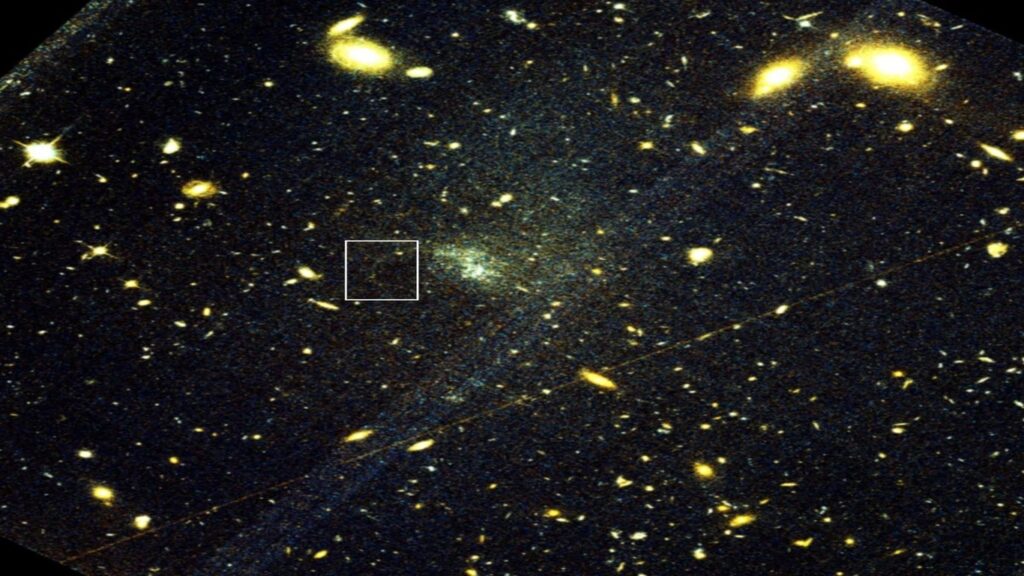
COPENHAGEN — Astronomers analyzing archival data from the Hubble Space Telescope have discovered the first globular cluster stellar stream ever detected outside the Milky Way.
Published in Nature, the milestone finding reveals a faint trail of stars in an ultra-diffuse dwarf galaxy roughly 115 million light-years from Earth. The discovery provides researchers with an entirely new observational tool to probe and map dark matter—the mysterious, invisible substance that makes up an estimated 80% to 85% of all matter in the universe.
How a Faint Ribbon of Stars Reveals Cosmic Gravitational Secrets
Stellar streams are created through a process known as tidal stripping, where the gravitational pull of a host galaxy gradually tears apart a dense, gravitationally bound globular cluster of stars. As stars get pulled away, they stretch into a long, thin, ribbon-like trail following a shared orbit.
While astronomers have mapped dozens of stellar streams within the Milky Way, identifying them in external galaxies was previously considered nearly impossible due to how faint their light signals are.
-
The Host Galaxy (UGC 9050-Dw1): The stream was detected inside an ultra-diffuse galaxy. Because ultra-diffuse galaxies contain very few stars spread over a wide area, the stream stood out clearly against the dark background.
-
A New Tool for Extragalactic Dark Matter: Because a stream’s shape and orbit are dictated entirely by gravity, modeling the stream allows scientists to calculate the galaxy’s total mass. Subtracting the visible mass of stars reveals how much hidden dark matter is holding the galaxy together.
-
Validation of Astrophysical Models: Led by doctoral researcher Julie Kiel Holm of the Niels Bohr Institute at the University of Copenhagen, the team confirmed that extragalactic stream modeling yields dark matter measurements that match previous theoretical expectations.
Extragalactic Stellar Stream Discovery Snapshot:
• Target Object: Globular cluster stellar stream in galaxy UGC 9050-Dw1
• Distance from Earth: ~115 Million Light-Years
• Primary Observatory: NASA/ESA Hubble Space Telescope (Archival Data)
• Research Lead: Julie Kiel Holm (Niels Bohr Institute / University of Copenhagen)
• Journal Publication: Nature (August 2026)
Probing the Nature of Dark Matter Across the Universe
Understanding the nature of dark matter remains one of the fundamental unsolved questions in modern physics. Because dark matter neither emits nor absorbs light, astronomers can only detect it through its gravitational impact on visible objects.
Strategic Implications for Future Astronomy
-
Searching for Dark Matter Clumps: Scientists theorize that when small concentrations or sub-halos of dark matter pass through a stellar stream, they leave distinct gaps or clumps. Finding these gaps in extragalactic streams will help confirm key properties of dark matter particles.
-
Beyond the Milky Way: Until now, stellar stream analysis for dark matter was confined exclusively to our home galaxy. Expanding this technique to distant galaxies allows researchers to study dark matter behavior across diverse environments throughout the cosmos.
-
Next-Generation Space Observatories: Researchers expect a surge in extragalactic stream discoveries with upcoming wide-field space observatories, such as NASA’s Nancy Grace Roman Space Telescope, which features a field of view 100 times larger than Hubble.
Expanding the Search for Cosmic Breadcrumb Trails
The discovery of the stream in UGC 9050-Dw1 establishes a practical framework for mapping dark matter in galaxies far beyond our local neighborhood.
As astronomers mine deep-sky surveys for additional stellar streams, these cosmic breadcrumb trails promise to accelerate humanity’s understanding of how galaxies form, evolve, and interact with the invisible universe.










Comment