


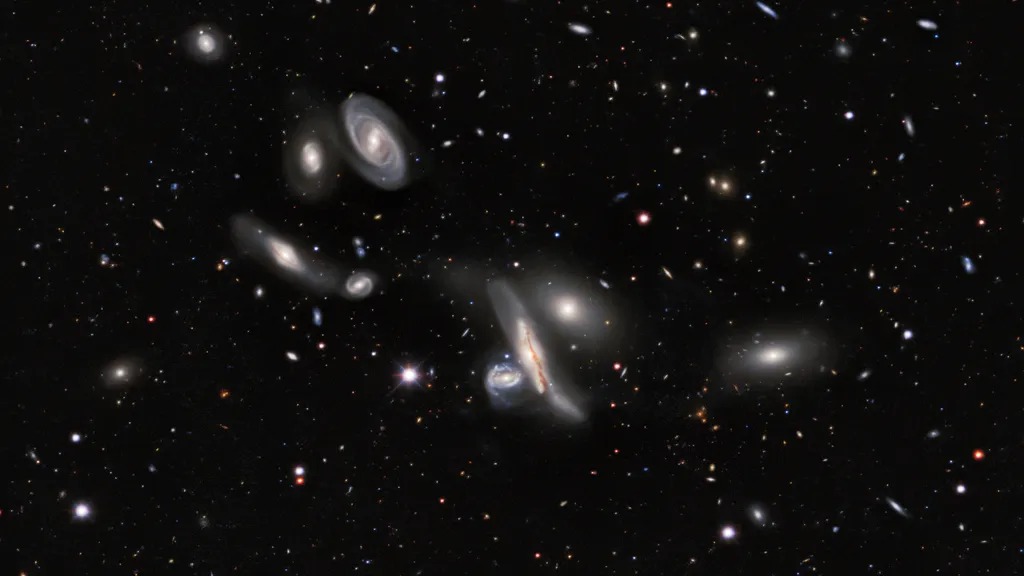
BERKELEY, Calif. — Astronomers and astrophysicists have officially unveiled the largest two-dimensional color map of the universe ever assembled.
Created by the DESI Legacy Imaging Surveys team, the monumental 5.6-trillion-pixel digital survey catalogs nearly 4 billion celestial objects across roughly 75 percent of the night sky.
The publicly available dataset combines 13 years of observations, offering scientists, researchers, and citizen scientists an unprecedented high-resolution lens into cosmic structures, dark matter, and the ongoing expansion of the universe.
13 Years of Sky Survey Data Power 5.6-Trillion-Pixel Cosmic Map
The landmark map is the culmination of more than a decade of international collaboration led by the U.S. Department of Energy’s Lawrence Berkeley National Laboratory (Berkeley Lab).
By stitching together 263,407 individual telescope exposures collected across 2,285 nights, the team constructed a seamless, ultra-deep photograph of the cosmos.
-
Sky Coverage: Covers 75 percent of the night sky in both visible and near-infrared wavelengths, focusing on extragalactic regions cleared of Milky Way dust.
-
Massive Catalog: Charts nearly 4 billion stars, distant spiral galaxies, quasars, black holes, and local asteroids.
-
Supercomputer Processing: Data integration required eight weeks of intensive processing on the Perlmutter supercomputer at NERSC.
-
Observatory Network: Built using data from the NSF Mayall Telescope in Arizona, the NSF Blanco Telescope (equipped with the Dark Energy Camera, DECam) in Chile, and NASA’s WISE infrared satellite mission.
DESI Legacy Imaging Surveys Dataset Snapshot:
• Total Pixels: 5.6 Trillion
• Cataloged Objects: ~4 Billion (Stars, Galaxies, Quasars, Asteroids)
• Night Sky Coverage: ~75%
• Telescope Exposures Combined: 263,407
• Processing Time: 8 Weeks on Perlmutter Supercomputer
• Public Access: Available globally via the Legacy Survey Sky Viewer
Laying the Groundwork for 3D Cosmic Mapping and Dark Energy Research
While the 2D map records the precise angular positions and brightness of billions of cosmic bodies, its main mission is serving as the foundational foundation for 3D spectroscopic mapping.
The survey directly targets candidate galaxies and quasars for the Dark Energy Spectroscopic Instrument (DESI), which measures red-shifts to add a distance dimension and study cosmic acceleration.
Scientific Breakthroughs Enabled by the Survey
-
Unlocking Dark Energy: By mapping galaxy clustering across billions of light-years, scientists are testing whether dark energy evolves over cosmic time or remains a cosmological constant.
-
Hunting Gravitational Lenses: Researchers are leveraging the high-resolution dataset to locate rare gravitational lenses—where massive foreground galaxies bend light from background objects, revealing hidden concentrations of dark matter.
-
Publicly Accessible Exploration: The entire survey is open-source and navigable online via the Legacy Survey Sky Viewer, allowing amateur astronomers to explore distant features like the spiral galaxy Messier 96.
Global Impact on Future Astronomical Discoveries
Astronomers anticipate that this 2D map will remain the most detailed sky survey for years to come, serving as an indispensable tool for observational astronomy.
As DESI continues its multi-year spectroscopic campaign, the dataset provides a lasting, open-access foundation for exploring the origins, structure, and ultimate fate of our universe.











Comment