


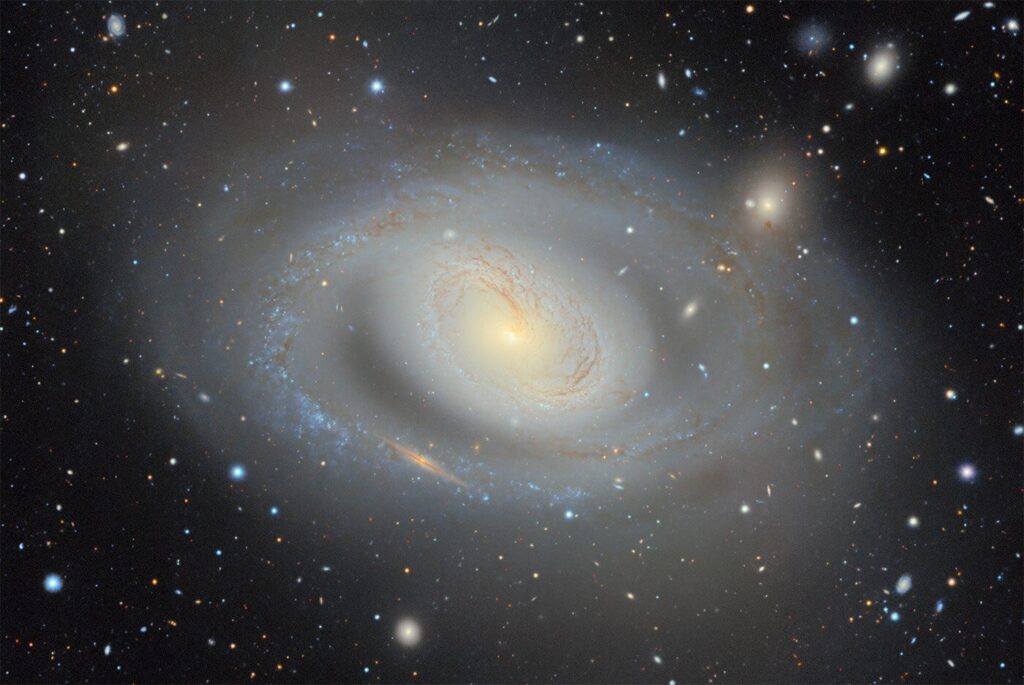
BERKELEY, Calif. — The DESI Legacy Imaging Surveys team has officially released the largest 2D color map of the universe ever constructed—a 5.6-trillion-pixel digital survey cataloging nearly 4 billion stars, galaxies, and cosmic phenomena across 75% of the extragalactic sky.
Thirteen years in the making, the monumental astronomical dataset combines over 263,000 individual telescope exposures, offering researchers and citizen scientists unprecedented access to explore physics’ deepest mysteries, including dark matter and dark energy.
5.6-Trillion-Pixel Sky Survey Unveils Billions of Galaxies
The updated survey provides the most comprehensive deep-sky picture in visible and near-infrared light to date.
By observing regions unobscured by the dust and dense star fields of our own Milky Way galaxy, the map records the precise locations and brightness of celestial bodies across billions of light-years.
-
Massive Astronomical Scale: Contains nearly 4 billion mapped objects, including distant spiral galaxies, quasars, supernovae, and gravitational lenses.
-
Supercomputer Processing: Synthesized from 2,285 nights of observations processed on the Perlmutter supercomputer at the National Energy Research Scientific Computing Center (NERSC).
-
Public Accessibility: The entire dataset is open-access and viewable globally through the interactive Legacy Survey Sky Viewer platform.
DESI 2D Map Specifications:
• Resolution: 5.6 Trillion Pixels
• Sky Coverage: ~75% of the extragalactic sky
• Mapped Objects: ~4 Billion celestial bodies
• Data Sources: 263,407 exposures across 3 observatories (DECaLS, MzLS, BASS)
• Primary Purpose: Target selection for 3D spectroscopic dark energy mapping
Foundation for 3D Cosmic Expansion and Dark Energy Research
The 2D survey serves as the essential foundational roadmap for the Dark Energy Spectroscopic Instrument (DESI), which measures light wavelengths to determine object distances and construct the world’s largest 3D map of the universe.
Investigating the Nature of Dark Energy
-
Target Selection: Astronomers use the high-resolution 2D images to select target galaxies for DESI’s fiber-optic spectrograph system.
-
Measuring Cosmic Acceleration: By mapping how galaxies cluster across cosmic time, scientists track the influence of dark energy—the mysterious force driving the universe’s accelerating expansion.
-
Evolving Physics Models: Early DESI findings released earlier in 2026 revealed unexpected hints that dark energy’s strength may be changing over time, potentially shifting established cosmological theories.
Global Scientific Collaboration and Open-Source Astronomy
Built through an international collaboration involving over 160 scientists across institutions including Lawrence Berkeley National Laboratory, NSF NOIRLab, and the Department of Energy, the survey will remain the standard astronomical reference for years to come.
Beyond dark energy research, the open-access database enables global researchers and amateur astronomers to discover rare gravitational lenses, track asteroids, and study the structural evolution of galaxies across the cosmos.










Comment