


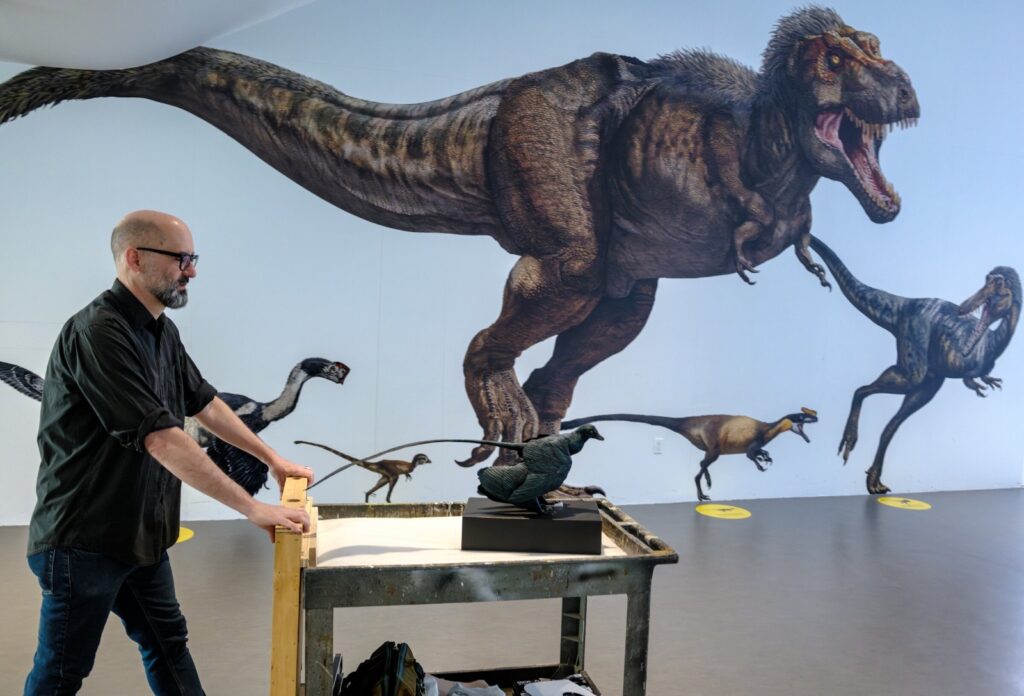
NEW YORK, NY, USA — A new study led by researchers from the American Museum of Natural History and Princeton University has uncovered a surprising evolutionary puzzle: why non-avian dinosaurs never evolved into truly tiny creatures comparable to modern mice, shrews, or hummingbirds.
While dinosaurs are universally remembered as Earth’s giants—ranging from towering multi-ton sauropods to apex predators like Tyrannosaurus rex—their lower size limit remained remarkably high. Despite more than 170 million years of diversification, the smallest known non-avian dinosaurs weighed roughly 450 grams (about one pound), roughly the size of a large rabbit.
Researchers investigating vertebrate body size distributions found that physiological models alone fail to explain this striking absence of miniature dinosaur species.
Why Weren’t There Mouse-Sized Dinosaurs?
The apparent lack of micro-dinosaurs is not simply a gap in the fossil record. While tiny bones are fragile, fossil beds that successfully preserved delicate remains of small mammals, lizards, and amphibians yielded virtually no miniature non-avian dinosaurs.
-
Ecological Competition: Early mammals had already adapted to small-bodied niches, successfully exploiting food sources, burrows, and shelter before dinosaurs became ecologically dominant.
-
Physiological Limits vs. Environment: Mathematical models tracking energy intake and reproductive output showed that physiological constraints alone couldn’t prevent miniaturization, pointing instead to external ecological pressures.
-
Predation and Habitat Structure: Small dinosaurs may have faced intense predation pressure or struggled to compete with established, fast-reproducing small mammals.
Implications for Modern Biodiversity and Future Research
The study highlights that evolutionary paths are shaped as much by available ecological opportunities and competition as they are by an organism’s physical capabilities.
Key Takeaways for Paleontology
-
The Bird Exception: While non-avian dinosaurs maintained a high lower-size boundary, avian dinosaurs eventually unlocked miniature sizes, giving rise to modern birds like the bee hummingbird.
-
The Value of Absences: Understanding why certain body sizes remained vacant during the Mesozoic Era offers deeper insight into how modern ecosystems and global biodiversity are structured.










Comment