


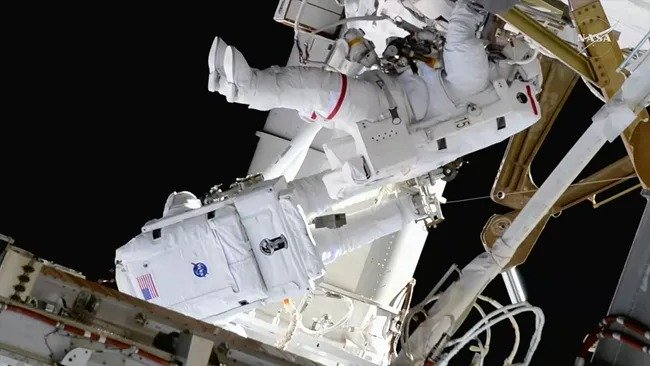
HOUSTON, TEXAS — NASA astronauts aboard the International Space Station (ISS) successfully completed a rigorous 6.5-hour spacewalk outside the orbiting laboratory, marking another major milestone in the ongoing mission to upgrade the station’s power generation systems.
Key Objectives of the Orbital Spacewalk
Stepping out of the Quest airlock, the spacewalking duo tackled a series of complex installation and preparation tasks designed to modernize the station’s aging electrical grid.
Core Tasks Completed in Microgravity
-
Mounting Support Structures: The crew successfully assembled and secured modified mounting brackets on the station’s truss structure.
-
Routing Power Cables: Astronauts integrated heavy-duty cabling to bridge the station’s primary power channels with upcoming solar array roll-out installations.
-
Thermal Protection Checks: Technicians inspected and secured insulation blankets around critical electronics boxes to withstand intense orbital temperature fluctuations.
Powering the Future of Space Research
With the station’s original solar arrays gradually degrading after decades of continuous exposure in low Earth orbit, NASA has been rolling out advanced Roll-Out Solar Arrays (iROSA) to boost the station’s total power capacity.
Why the Upgrades Matter
-
Boosting Available Wattage: The new arrays increase the ISS’s total power generation from 160 kilowatts to an impressive 215 kilowatts, ensuring sufficient energy for heavy scientific workloads and commercial research.
-
Extending ISS Operational Lifespan: Upgrading the power supply is a vital prerequisite for maintaining crew safety and station functionality through the remainder of its operational lifetime.
Mission control in Houston confirmed that all spacesuit telemetry systems functioned smoothly and that the day’s primary objectives were fully met, setting the stage for the upcoming delivery and installation of the next batch of solar hardware.










Comment