


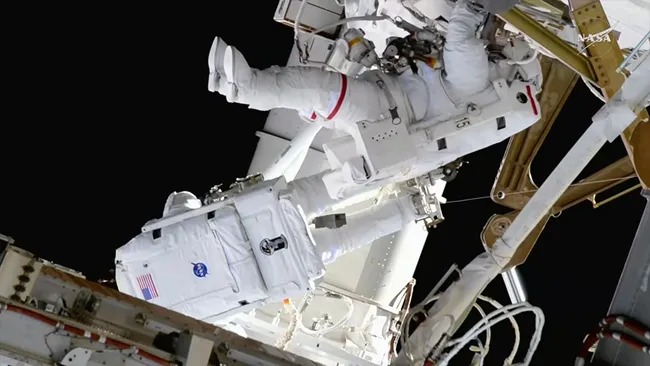
WASHINGTON, DC, USA — NASA astronauts Jessica Meir and Anil Menon successfully concluded a 6.5-hour spacewalk outside the International Space Station (ISS) to set up critical infrastructure for upcoming power system upgrades.
The excursion, designated as US Spacewalk 96, marked the 281st spacewalk dedicated to space station assembly, maintenance, and structural upgrades. For veteran astronaut Jessica Meir, the mission marked her sixth career spacewalk, while fellow NASA crewmate Anil Menon completed his very first time working directly in the vacuum of space.
Objectives and Technical Breakdown of US Spacewalk 96
Operating from the exterior of the orbital laboratory, the duo focused on laying structural foundations to optimize the station’s energy capture capabilities.
-
Targeting the 3B Power Channel: The primary objective centered on installing specialized mounting hardware and modification kits on the station’s Starboard 6 truss segment.
-
Paving the Way for IROSA: The structural work prepares the platform for the future integration of additional International Space Station Roll-Out Solar Arrays (IROSA).
-
Routing Power and Insulation: Astronauts securely connected cables designed to channel electricity from the future solar arrays into the station’s grid, finishing the struts with multi-layer insulation.
Why the Power Upgrades Matter
The ongoing integration of IROSA units plays a vital role in sustaining the aging orbital complex.
Long-Term Station Goals
-
Boosting Energy Output: The new roll-out arrays significantly augment power capacity to support critical ongoing laboratory research and station systems.
-
Supporting Future Operations: Ensuring a stable, heightened power flow is essential for managing daily activities as well as supporting the station’s eventual safe and controlled deorbit procedures.








Comment