


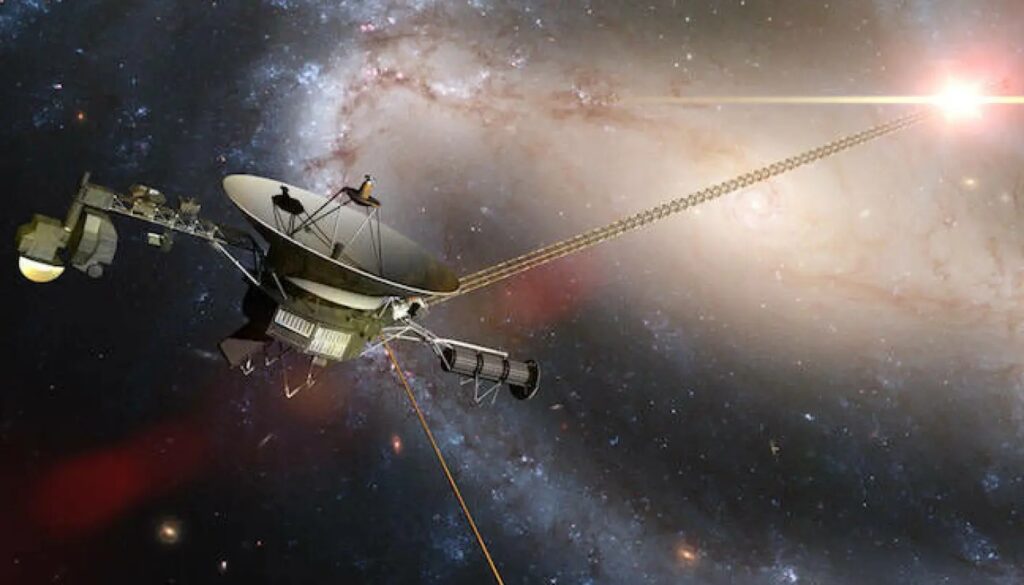
PASADENA, Calif. — Engineeers at NASA’s Jet Propulsion Laboratory (JPL) have unlocked a clever power management fix that will extend operational capabilities for the legendary Voyager 1 and Voyager 2 spacecraft through at least 2028.
As the twin interstellar probes—launched in 1977—reach their 50th year in space, decaying radioisotope thermoelectric generators (RTGs) continue to present critical power constraints. The newly devised engineering workaround allows scientists to keep instruments running as Voyager continues humanity’s deepest exploration of interstellar space.
How NASA Engineers Unlocked Extra Electrical Power for Voyager
Both Voyager spacecraft generate power using plutonium-238 decay, losing roughly four watts of output per year. To compensate, mission managers previously shut down non-essential heaters, primary subsystems, and secondary sensors.
Faced with impending instrument shutdowns, JPL flight team engineers devised a creative solution targeting voltage regulation safety margins.
-
Reallocating Voltage Margins: Engineers disabled a safety mechanism that smoothed out minor voltage fluctuations, freeing up extra power reserves for science payloads.
-
Prioritizing Science Instruments: The reclaimed power allows key interstellar sensors—including plasma wave instruments and magnetometers—to remain fully operational rather than being powered down.
-
Interstellar Operations Extended: The two-year extension provides continuous, real-time data collection from beyond the heliosphere, more than 15 billion miles from Earth.
Voyager Power Management Mission Status:
• Spacecraft: Voyager 1 & Voyager 2
• Distance from Earth: >15 Billion Miles (Interstellar Space)
• Power Source: Radioisotope Thermoelectric Generators (RTGs)
• Annual Power Loss Rate: ~4 Watts / Year
• Mission Extension Outcome: Extended operational life through at least 2028
Engineering Marvel: Operating 1970s Space Technology in Deep Space
Operating decades-old computer systems and hardware across a multi-billion-mile radio communications gap presents extraordinary technical challenges for NASA’s flight controllers.
Key Innovations Behind the Extension
-
Dynamic Voltage Oversight: Rather than relying on hardware safety buffers built into 1970s power distribution units, engineers monitor voltage levels continuously from ground stations.
-
Accepting Calculated Risks: Mission planners determined that the minimal risk of small voltage spikes was worth taking to preserve active scientific data gathering.
-
Deep Space Network Integration: Ground teams rely on NASA’s giant 70-meter Deep Space Network dishes in Goldstone, Madrid, and Canberra to transmit precise commands and capture faint signal downlinks.
Continuing Humanity’s Deepest Interstellar Mission
As Voyager 1 and Voyager 2 venture further into the galaxy, every extra day of operational data offers astrophysicists invaluable insights into interstellar magnetic fields, cosmic rays, and solar wind boundaries.
Thanks to the ingenuity of NASA engineers, these iconic spacefarers will continue transmitting historic deep-space discoveries back to Earth as they approach half a century of spaceflight.











Comment