


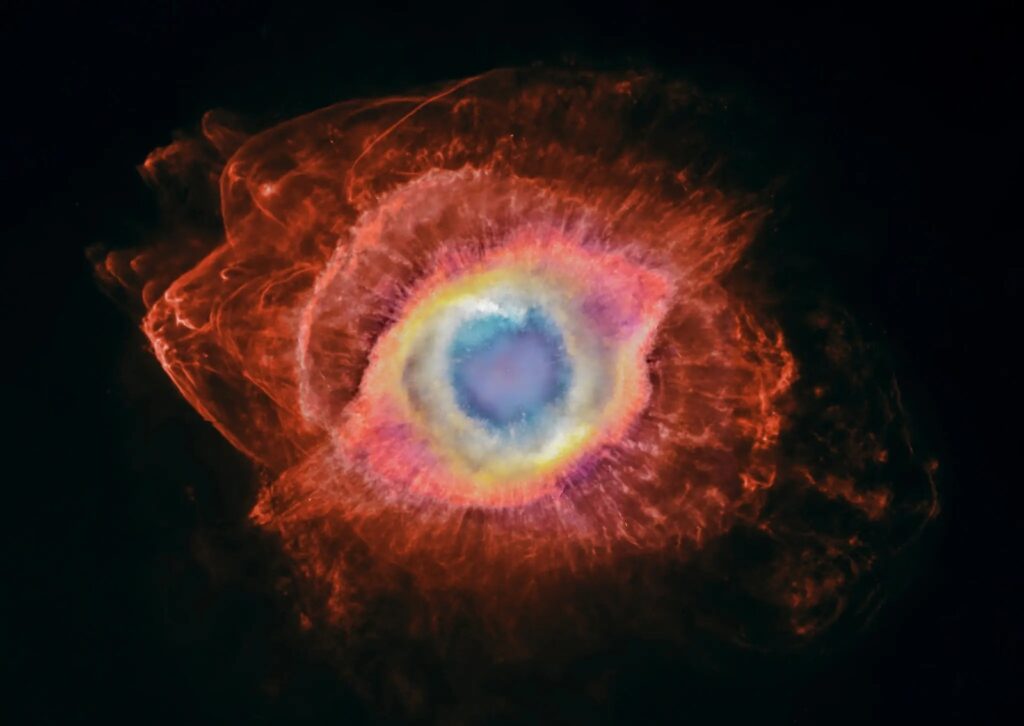
EL SAUCE OBSERVATORY, Chile — Astronomers using the groundbreaking MOTHRA telescope in Chile have captured an extraordinary, unseen phenomenon surrounding the famous Helix Nebula, revealing how dying stars return vital elements to interstellar space to forge future stars and planets.
During what was supposed to be a routine calibration test, the array of high-grade telephoto lenses detected 22 previously hidden, bow-shaped shock waves—tracing gas and stellar debris as it is stripped, shredded, and recycled into the galaxy.
Accidental Discovery Hidden in a Telescope Calibration Test
Located approximately 650 light-years from Earth in the constellation Aquarius, the eye-shaped Helix Nebula is one of the closest and most studied planetary nebulae in astronomy.
Because of its familiarity, researchers selected the nebula as a standard test subject for MOTHRA (Modular Optical Telephoto Hyperspectral Robotic Array), a revolutionary telescope under construction at the El Sauce Observatory.
-
Surprise Findings: While photographing the faint outer halo, MOTHRA’s sensitive all-lens optical array revealed 22 complete or partial bow shocks where fast-moving stellar debris collides with surrounding interstellar gas.
-
Early-Stage Power: The discovery was made using only a fraction of MOTHRA’s planned capability—equivalent to just 20 minutes of observation with five active mounts out of an eventual 1,140 telephoto lenses.
-
Published Research: The findings, published in Nature, detail a long-sought missing link in the cosmic recycling process that distributes carbon, oxygen, and heavy elements throughout space.
MOTHRA Telescope Discovery Fast Facts:
• Location: El Sauce Observatory, Chile
• Target: Helix Nebula (650 light-years away in Aquarius)
• Key Finding: 22 bow shocks revealing stellar debris shredding into gas
• Hardware Specs: All-lens array expanding to 1,140 telephoto lenses
• Lead Research Lead: Dragonfly Focused Research Organization (FRO) / Yale / Northwestern
Cosmic Recycling: How Dying Stars Seed the Universe with Life
The images provide an unprecedented look at how elements forged inside stars—the building blocks of future solar systems and organic life—break down and disperse.
Key Scientific Takeaways
-
Short Lifespan of Debris: Astronomers estimate that once stellar clumps collide with interstellar gas, they remain intact for only about 10,000 years before completely dissolving into diffuse gas.
-
A Preview of the Sun’s Future: The central white dwarf in the Helix Nebula offers a realistic preview of what will happen to our own Sun in roughly 5 billion years as it expands, sheds its outer layers, and recycles its material into the Milky Way.
-
Advanced Optical Innovation: MOTHRA’s unique design uses specialized telephoto lens arrays to overcome light-scattering issues common in traditional mirror-based reflection telescopes, enabling it to detect ultra-faint gas clouds.
What’s Next for the MOTHRA Telescope Project
As construction continues on MOTHRA’s full 1,140-lens array, astronomers anticipate that the telescope will uncover thousands of faint, previously invisible structures across the night sky.
The successful detection of the Helix Nebula’s outer shocks proves the instrument’s potential to redefine our understanding of galactic evolution, stellar deaths, and the continuous birth of new solar systems.










Comment