


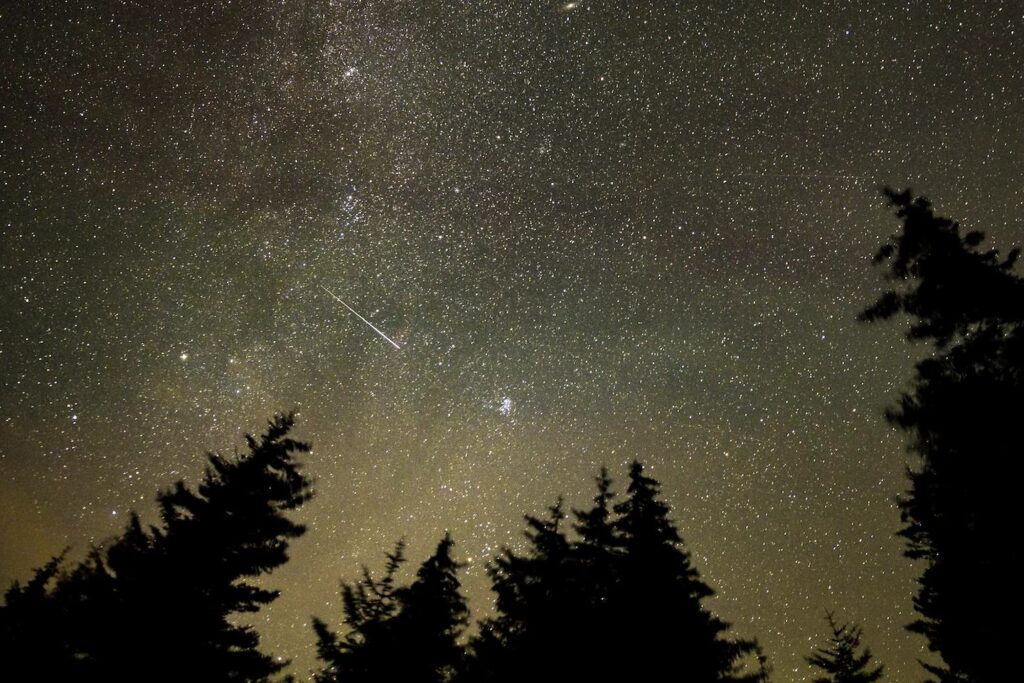
WASHINGTON — Skywatchers across the globe are preparing for an extraordinary astronomical event as the peak of the annual Perseid meteor shower coincides directly with a solar eclipse, creating a rare daytime-to-nighttime cosmic spectacle.
The dual event offers astronomers and backyard stargazers an optimal viewing window, with the moon’s position providing dark skies for meteor watching after the daytime solar alignment concludes.
Rare Dual Astronomical Event: Day and Night Sky Shows
The rare alignment couples a partial-to-total solar eclipse during daylight hours with peak activity from the Perseid meteor shower overnight.
Because a solar eclipse requires a New Moon—when the moon passes directly between the Earth and the Sun—the night sky will be virtually free of bright moonlight, offering ideal conditions to view shooting stars.
-
Daytime Event: The Moon aligns with the Sun, creating a total solar eclipse across parts of Greenland, Iceland, and Spain, while casting a partial solar eclipse over North America and parts of Western Europe.
-
Nighttime Event: Hours after sunset, Earth’s passage through the dust trail of Comet 109P/Swift-Tuttle delivers up to 50 to 90 meteors per hour during peak overnight hours.
-
Moon Phase Advantage: The zero-percent illuminated New Moon ensures the absence of lunar glare, making fainter meteors far easier to spot than in typical years.
August Celestial Event Schedule:
• Daytime: Solar Eclipse (Total in Europe/Greenland; Partial in N. America)
• Peak Time (US East Coast Partial Eclipse): Mid-afternoon
• Nighttime: Perseid Meteor Shower Peak (Overnight to Pre-Dawn)
• Expected Meteor Rate: 50–90 meteors per hour under dark rural skies
How and Where to Watch the Perseids and Solar Eclipse
Astronomers stress that viewing requirements for the two events are entirely different, requiring specific preparation for daytime solar observation and late-night stargazing.
Solar Eclipse Viewing Protection
-
Approved Eye Protection Needed: Looking directly at the Sun during the partial eclipse without certified ISO 12312-2 solar viewing glasses can cause severe eye damage. Standard sunglasses are insufficient.
-
Regional Visibility: Viewers in 26 U.S. states and Washington, D.C., can observe a partial eclipse during the day, while skywatchers in parts of Europe will witness complete totality near sunset.
Optimizing Your Perseid Meteor Viewing
-
No Equipment Required: Telescopes and binoculars are not recommended for meteor watching, as they restrict your field of view. The naked eye is best for capturing fast-moving streaks.
-
Timing and Dark Skies: Head away from urban light pollution after midnight. Allow at least 30 minutes for your eyes to fully adapt to the dark, avoiding smartphone screens.
Understanding the Science Behind Comet Swift-Tuttle
The Perseid meteor shower occurs annually as Earth orbits through the cloud of ice, dust, and rock fragments left behind by Comet 109P/Swift-Tuttle, a 16-mile-wide comet that orbits the Sun every 133 years.
As these tiny fragments—most no larger than a grain of sand—enter Earth’s upper atmosphere at speeds exceeding 37 miles per second (133,000 mph), atmospheric friction heats the surrounding air, creating the brilliant streaks of light commonly called shooting stars.










Comment