


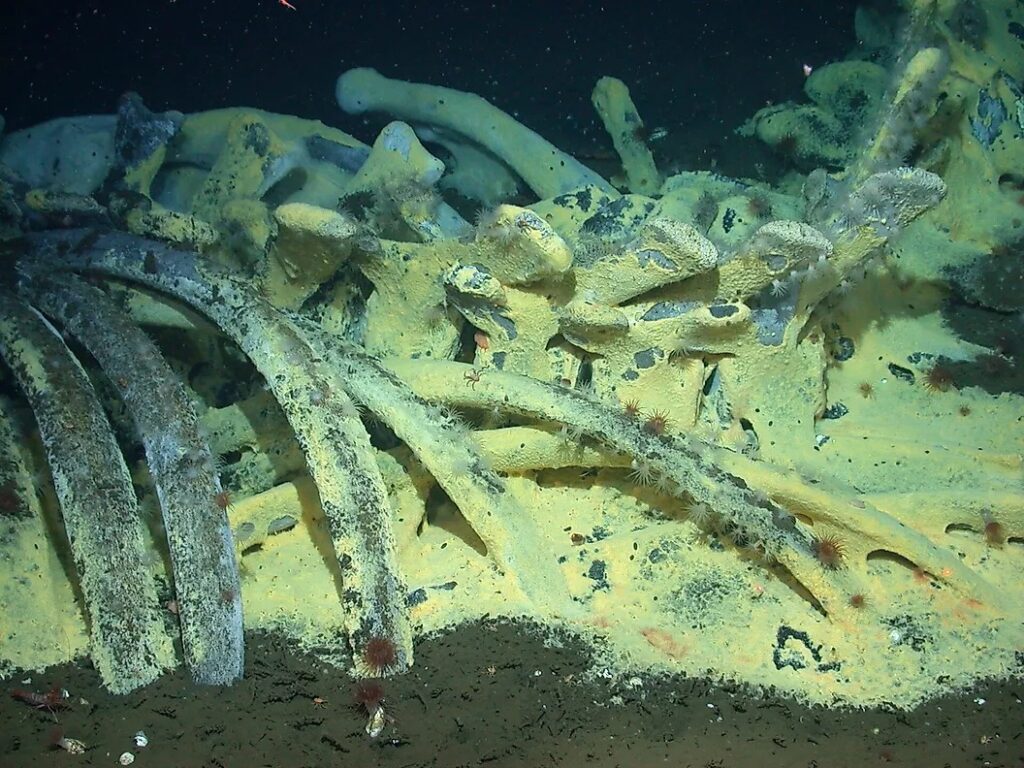
OCEANS WORLDWIDE — When one of the ocean’s gentle giants passes away, its journey does not end at the surface. Instead, a deceased whale embarks on a rare and extraordinary ecological process known as a whale fall, creating a thriving deep-sea oasis that sustains marine life for decades.
The Final Descent: From Surface to Seafloor
The journey of a whale carcass begins with its descent. While a small percentage of whales wash ashore, the vast majority sink into the abyssal depths, plunging thousands of feet below the ocean surface.
As the massive body drifts downward, it serves as an immediate, high-caloric feast for pelagic scavengers. Sharks, large fish, and mobile crustaceans quickly gather to feed on the nutrient-rich blubber and muscle tissue, consuming a massive portion of the carcass before it even reaches the ocean floor.
Stages of the Descent
-
The Mobile Scavenger Phase: Active predators strip away the soft tissues within months, utilizing an unexpected windfall of food in an otherwise nutrient-sparse environment.
-
Reaching the Benthic Zone: Once the remaining skeleton and heavy tissue settle onto the dark, cold seafloor, a completely new ecological phase begins.
The Whale Fall Ecosystem: A Deep-Sea Oasis
Once settled on the sediment, a whale fall transforms into a complex, multi-decade biological community. Scientists divide this prolonged process into distinct stages characterized by specialized organisms.
The Opportunistic and Sulfophilic Phases
-
Bone-Eating Worms (Osedax): Bizarre, root-like marine worms—often called “zombie worms”—colonize the exposed bones, secreting acid to dissolve the skeletal structure and feed on the lipids trapped inside.
-
Microbial Mats and Mussels: In the final stages, anaerobic bacteria break down the lipids embedded deep within the whale bones, producing hydrogen sulfide. This chemical energy supports dense mats of bacteria, specialized clams, and crabs that thrive through chemosynthesis rather than sunlight.
Why Whale Falls Matter for Marine Biodiversity
Marine biologists emphasize that whale falls act as evolutionary stepping stones in the deep ocean, providing isolated deep-sea species with abundant resources to survive and evolve across vast distances. Understanding these natural phenomena highlights the intricate, interconnected web of life spanning from the sunlit surface to the deepest ocean trenches.












Comment